The Parable of Lazarus and the Rich Man is both illuminating and sobering. Once again, Stephen March explains what Jesus is saying.
The Pharisees Ridicule Jesus
In our last study, we looked at the parable of the dishonest manager, which ended by Jesus saying, “You cannot serve God and money.” The very next verse in the Bible tells us of the interesting response that the Pharisees had to this idea.
In Luke 16:14 it says
“The Pharisees, who were lovers of money, heard all these things, and they ridiculed him.”
Luke 16:14
They made fun of Jesus for telling them that you can’t have it both ways. Now remember, the parable he had just finished speaking wasn’t about it being wrong to have money or material possessions. There is nothing wrong with that in and of itself. The parable was warning us to be mindful of the importance of those things to us, and what we use them for. Simply put, we shouldn’t chase after riches, and whatever things we do have, should be used for God’s glory and purposes, not to make something of ourselves.
The Pharisees Felt Justified in Their Wealth
That’s why the Pharisees mocked him. Who was he to tell them they were wrong. Not only that, but from what happened next, it seemed as though the Pharisees felt justified in the wealth they had amassed while acting as God’s chosen servants and leaders. Perhaps “acting” though is the key word there. Jesus’ response to their ridicule began like this, “You are those who justify yourselves before men, but God knows your hearts. For what is exalted among men is an abomination in the sight of God.”
What he is telling them, is that they have used their position of authority to build themselves up in the sight of man, and though the outward appearance may seem holy, though they may declare themselves justified in using their position to attain wealth and power, God knows that in their hearts they don’t serve him, they serve themselves. Their lives are evil in God’s sight. This is not exactly what someone wants to hear when they are trying to convince everyone that they are righteous. Furthermore, Jesus gets right to the point of where their attitudes and lifestyle will lead, by sharing with them this parable.
The Rich Man and Lazarus
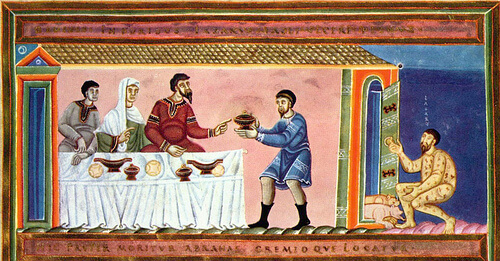
“There was a rich man who was clothed in purple and fine linen and who feasted sumptuously every day. And at his gate was laid a poor man named Lazarus, covered with sores, who desired to be fed with what fell from the rich man’s table. Moreover, even the dogs came and licked his sores. The poor man died and was carried by the angels to Abraham’s side. The rich man also died and was buried, and in Hades, being in torment, he lifted up his eyes and saw Abraham far off and Lazarus at his side. And he called out, ‘Father Abraham, have mercy on me, and send Lazarus to dip the end of his finger in water and cool my tongue, for I am in anguish in this flame.’ But Abraham said, ‘Child, remember that you in your lifetime received your good things, and Lazarus in like manner bad things; but now he is comforted here, and you are in anguish. And besides all this, between us and you a great chasm has been fixed, in order that those who would pass from here to you may not be able, and none may cross from there to us.’ And he said, ‘Then I beg you, father, to send him to my father’s house— for I have five brothers—so that he may warn them, lest they also come into this place of torment.’ But Abraham said, ‘They have Moses and the Prophets; let them hear them.’ And he said, ‘No, father Abraham, but if someone goes to them from the dead, they will repent.’ He said to him, ‘If they do not hear Moses and the Prophets, neither will they be convinced if someone should rise from the dead.’”
Luke 16:19-31
A Look at Death and the Afterlife
In this parable, Jesus is giving an allegorical look at death and the afterlife. It is important to note before we dive into the meaning of this parable, that this is not a true representation of heaven, or hell. The Jews believed in paradise, where the faithful go, and death, where the unfaithful go, and that is the setting for this story. The true heaven, and particularly access to it, would not be available until Jesus had completed his sacrificial work on the cross, risen from the dead, and ascended to His Father. That is a completely different theological study that we won’t delve into today.
A Story of the Haves and Have Nots
The story itself is pretty easy to navigate through. You have the rich man, who has all the finery of life, wealth, possessions, luxurious food, and you have Lazarus, a poor beggar with no home. It’s a picture of the “haves” and the “have-nots.” In the direct context, the rich man is representative of the Pharisees, and Lazarus could be a picture of the disciples, the poor and needy, the blind, crippled, sinners, basically anyone the Pharisees thought to be beneath them.
The Rich Man Does Nothing to Help
Little is said of either man, other than to indicate what their lives are like. Note though, that there is not any direct charge of wrongdoing laid against the rich man. It is simply stated that he was clothed in fine garments and feasted well every day. But that’s the problem Jesus is pointing out. Just outside this man’s gate is Lazarus. Described as a poor man, suffering from sores, hungry for even just scraps of food. If the rich man would just turn and look and see the need of this man, he would have been able to help.
Consumed by Lavish Living
That doesn’t happen though. The man is so consumed by his lavish living, that he takes no notice of Lazarus or his need. We can start to see the parallel with the Pharisees. They were so absorbed with their own lives, their own perceived righteousness, their own glory, that they could not see the deep need of those that a true righteous person, a true religious leader, would desire to help. These men thought they were doing God’s will by upholding the Law of Moses, shunning any one who went against their customs and traditions, pushing them away from God, rather than trying to draw them to God. They simply weren’t righteous at all by God’s standard.
Lazarus is Faithful to God
Now, let’s focus on Lazarus. Again, we know nothing of his life other than his circumstance. So, when we see in verse 22 that he died and was carried to Abraham’s side, which is an interpretation of paradise to the Jews, we can understand that he was faithful to God, despite his situation. This too was an important lesson to the Pharisees, as they believed that anyone who had such infirmities did so because of sin. Based on what happens with Lazarus here, Jesus is saying that is not the case, especially since the one that would have been viewed as being blessed by God does not go to paradise, but into death, or hades, a place of torment. This may have hit close to home for the Pharisees, as it became clear that they were the rich man in story.
The Conversation Between Lazarus and the Rich Man
Next, we get into the conversation between the rich man and Lazarus. Now again, this is an allegorical story, and not actually how heaven and hell work, but the conversation is designed to help show those listening the reality of what God expects from those who would be called righteous and faithful. There is an irony here too, the rich man doesn’t ask Abraham to cool his tongue, he asks for Lazarus, the man for whom he had no regard or compassion to be the one to help him in his time of need.
Abraham reminds the rich man that when he was alive, he had good things, and offered nothing to Lazarus. Abraham then proceeds to tell him that apart from that fact, it is impossible for Lazarus to cross over. Now, why bring that up? Is it merely to show that once our earthly lives are over there is no way to change our eternal destination? Perhaps, that is true based on everything we read in the Bible. Here is another thought though.
An Attitude of Love and Compassion
I think part of the reason for mentioning it, is that if it were up to Lazarus, and possible, he would have gone to the rich man and cooled his tongue. Two reasons for that, first, it is indicative of the Godly attitude of love and compassion that we all should have. Second, Lazarus knew what it was like to suffer. So that, coupled with a righteous attitude and faith, would drive him to show mercy.
Stinging Barbs For the Pharisees
This whole story would have been full of stinging barbs for the Pharisees. Godly life was revealed through true humility, lowliness, mercy and compassion. The Pharisees were proud, puffed up, unforgiving and indignant toward anyone they felt were beneath them. They were living completely opposite of what Micah 6:8 says,
“He has told you, O man, what is good; and what does the Lord require of you but to do justice, and to love kindness, and to walk humbly with your God?”
Micah 6:8
The fact that they had this verse and many others to guide them into what true righteous living was, only emphasized the last part of the parable.
A Chilling Foreshadow of What Was Coming
Finally, the rich man accepts his fate, but asks that Lazarus be sent to his family, to warn them about these realities. Again, Abraham refuses, saying they have the law and the prophets to tell them. The rich man responds they won’t hear those but will believe if someone goes to them from the dead. Abraham affirms to the man that no, if they won’t believe the scriptures, neither will they believe even if someone rises from the dead. This is a chilling foreshadow of what was to come.
The Pharisees Should Have Known
The Pharisees should have known what the scriptures said about the Messiah. If they understood and believed them, they would have seen Jesus for who He was, the Christ that had been promised. They would have listened to him when he told them they needed to repent and follow God’s ways of righteousness. They would have looked at the miracles he performed and acknowledged that He was the Son of God. But they didn’t. Instead, they handed him over to the Romans to be executed on a cross.
Even when Christ rose from the dead and appeared to many, they still wouldn’t believe. Their hearts had been hardened, petrified by years of pride and self-righteousness. They were unable to change, unable to show compassion, unable to believe. Just like the rich man in the story.
Using the Resources God Has Given Us
Now for us today, considering the last two parables we have looked at, about not building ourselves up but using the resources God has given us to help others, can we live like that. Can we acknowledge his design for mankind is best, believe in Jesus and try our best to live for him and like him, storing up for ourselves treasures in heaven as we do? Or will we harden our hearts to God, and devote ourselves to ourselves, amassing as much as we can in this life, only to lose everything in the next? The choice is ours to make. Which will you choose?
What have you learned from the Parable of Lazarus and the Rich Man? What is your response to Jesus’ parables? We would love to hear from you. Comment below or contact us at HopeStreamRadio.
Stephen March is President of FBH International and directs HopeStreamRadio. He graduated from the Broadcasting Program at Niagara College in 2001, and has previously worked in television production and post-production. Stephen lives in St. Catharines, Ontario, with his wife Corinne and their four children. He serves as an elder at Scottlea Gospel Chapel.










Leave a Reply